
Excruciating waits for suspects and defendants is evident in almost all criminal cases that are being investigated or prosecuted at the moment. The police, court system and prison system is over ran and understaffed and it is having a truly devastating affect on the administration of justice for all involved; the defendant, complainant, and witnesses. The announcement of a once-in-a-generation review of the criminal courts, made today by the Lord Chancellor, has been met with cautious optimism
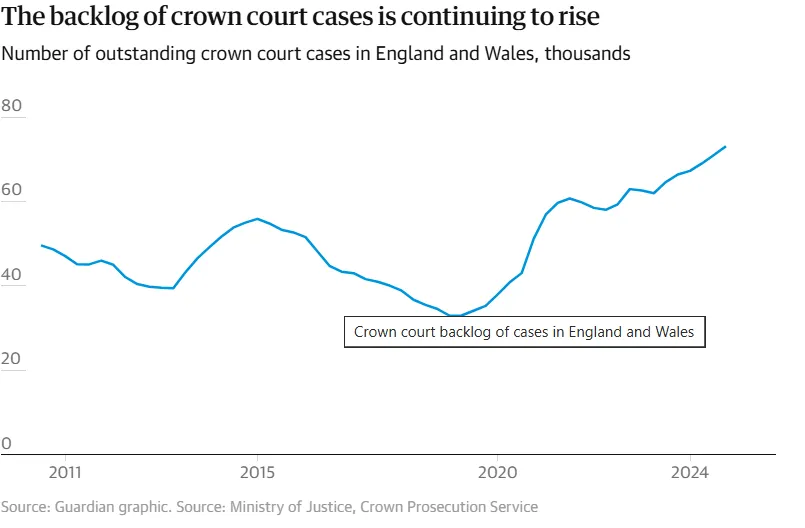
At this present time figures show that cases waiting to be dealt with by Crown Courts in England & Wales stood at
73,105 as of the end of September 2024 – a new record high.
A review, conducted by former High Court Judge Sir Brian Leveson, of the backlogs and the impact it is having on the criminal justice process has led to consideration being given to the introduction of ‘intermediate courts’. Intermediate Courts which will see trials in the Crown Court take place without a jury, with the aim being that this process will help speed up clearing the backlog of cases, and will see the courts back up and running to a sufficient and manageable standard. The proposal seems to suggest that a case which falls subject to this mode of trial would be heard by a Crown Court judge and two lay Magistrates. Additionally, there will be a focus on empowering magistrates to handle more serious cases, potentially freeing up Crown Court resources.
The cases which are likely to fall subject to the ‘intermediate courts’ are those that are deemed too serious for the Magistrates Court but deemed not serious enough for a Crown Court jury trial. This could include; low level indecent image cases, sexual assaults, domestic violence and sexual communication offences.
However, from a defence lawyers view, the implementation of such a process could lead to unfairness and could be disadvantageous to the accused, which could lead to more appeal applications being lodged, causing further backlogs for the Court of Appeal.
How Will Intermediate Courts Affect a Defendant?
The introduction of Crown Court hearings without a jury is for many going to be a frightening thought, and will take away the choice of being tried by a jury that defendants charged with either-way offences have. Where a suspect is charged with an offence it will fall into one of three categories:
Summary Only
A summary only offence is a criminal offence that can be heard only by the Magistrates Court and is deemed a less serious offence.
Indictable Only
Indictable only offences can be heard only in the Crown Court, these offences are of the most serious and include Rape, murder, and assault by penetration.
and;
Either Way
An either-way offence can be heard by the Magistrates Court or the Crown Court. Where a Magistrates Court accepts an either-way offence the defendant then has the opportunity to elect the Crown Court should they wish to do so. The main reason a defendant would be advised to elect the Crown Court is to have a trial by jury, to be tried by 12 ordinary members of the public and this is a very attractive mode of trial for many.
How Would Changes Work?
The review and proposals are in their very early stages and there will be no development of them until April 2025 at least. However, for the new system to be implemented and to work efficiently ensuring fairness to the accused, there are going to have to be changes throughout the whole system; including the reclassification of offences and clear guidance as to the function and powers of each role within the judiciary and also whether the appeal process would remain the same.